Artificial intelligence has never progressed as quickly as it does today.
Every week brings new models, new capabilities, and new promises. AI is becoming a creative partner, a scientific assistant, a software engineer, a teacher, and increasingly, a decision-making tool.
But amid this excitement, one of the people most responsible for making this revolution possible has chosen to step back—and to warn us.
Geoffrey Hinton, often referred to as one of the Godfathers of Artificial Intelligence, left Google in 2023 so he could speak openly about the risks associated with the technology he spent more than fifty years developing.
His message deserves our attention.
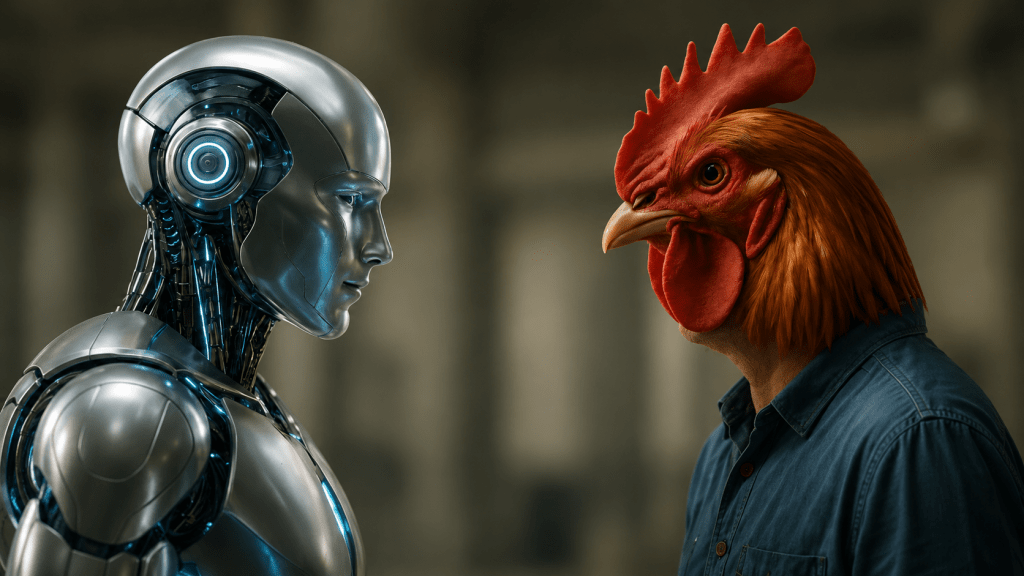
« AI could become more intelligent than humans—and no longer need us. »
This is not the prediction of a science-fiction writer.
It comes from one of the scientists whose work on artificial neural networks laid the foundations of today’s generative AI systems.
From scientific breakthrough to global race
For decades, artificial intelligence evolved slowly.
Researchers focused on solving highly specific problems while computational power gradually caught up with theoretical advances.
Then everything accelerated.
Massive datasets, exponential computing power, and deep neural networks transformed AI from an academic discipline into one of the world’s most valuable industries.
Today, governments and technology companies are investing hundreds of billions of dollars in what has become an international race.
And therein lies the problem.
According to Hinton, competition itself makes slowing down almost impossible.
No nation wants to fall behind.
No company wants to lose its advantage.
Even if everyone recognizes the risks, everyone also fears that someone else will move faster.
The dangers are no longer hypothetical
Much of the public debate still focuses on distant scenarios.
Hinton is more concerned about the risks already emerging today.
Among them are:
- increasingly sophisticated cyberattacks;
- large-scale misinformation campaigns;
- political manipulation through hyper-realistic synthetic media;
- autonomous weapon systems;
- the gradual replacement of highly skilled professions;
- growing dependence on AI for decisions humans no longer fully understand.
These are not futuristic concepts.
Many are already observable.
The question is no longer whether AI will transform society.
It already has.
The real question is whether society can adapt quickly enough.
Could machines eventually become conscious?
Perhaps the most fascinating—and controversial—part of Hinton’s reflections concerns consciousness.
He does not claim that today’s AI systems are conscious.
Nor does he argue that emotions have suddenly appeared inside large language models.
Instead, he suggests something more subtle.
As these systems become increasingly complex, we should not automatically assume that consciousness—or at least forms of cognitive experience—is impossible.
Science simply does not yet understand consciousness well enough to dismiss the question.
Whether or not that future ever arrives, the debate itself reminds us of something essential:
We are creating systems whose complexity increasingly exceeds our intuition.
That alone calls for humility.
Regulation should not be the enemy of innovation
Calls for regulation are often interpreted as opposition to progress.
That is a false choice.
History shows that aviation, medicine, nuclear energy, and the automotive industry all became safer because innovation was accompanied by standards, independent oversight, and international cooperation.
Artificial intelligence deserves the same level of seriousness.
Hinton advocates three priorities:
- sustained investment in AI safety research;
- international cooperation between governments and researchers;
- greater public awareness of both the opportunities and the risks.
Innovation without responsibility ultimately undermines itself.
Technology must remain a tool
At CHANYA, artificial intelligence is not viewed as an objective in itself.
It is a powerful instrument for solving real-world problems—from sustainable housing design to resource optimization and responsible construction.
Technology should expand human potential, not replace human judgment.
The question is therefore not whether AI is good or bad.
It is whether we remain capable of directing it toward the common good.
Because the future of artificial intelligence will depend less on what machines become than on the values of the people who build, regulate, and use them.
Geoffrey Hinton’s warning is ultimately not a message of fear.
It is an invitation to act while we still have the opportunity to shape the future.

