For generations, we have built homes as if tomorrow would always look like yesterday.
We designed neighborhoods for predictable weather, familiar seasons, and historical climate records. We trusted that what had worked for decades would continue to work for decades more.
But reality has changed.
Every year, hurricanes become more destructive, wildfires spread farther, floods reach places once considered safe, and heatwaves place unprecedented stress on buildings and infrastructure. Around the world, communities are discovering that the greatest threat is not always the disaster itself—it is the vulnerability of what we choose to build.
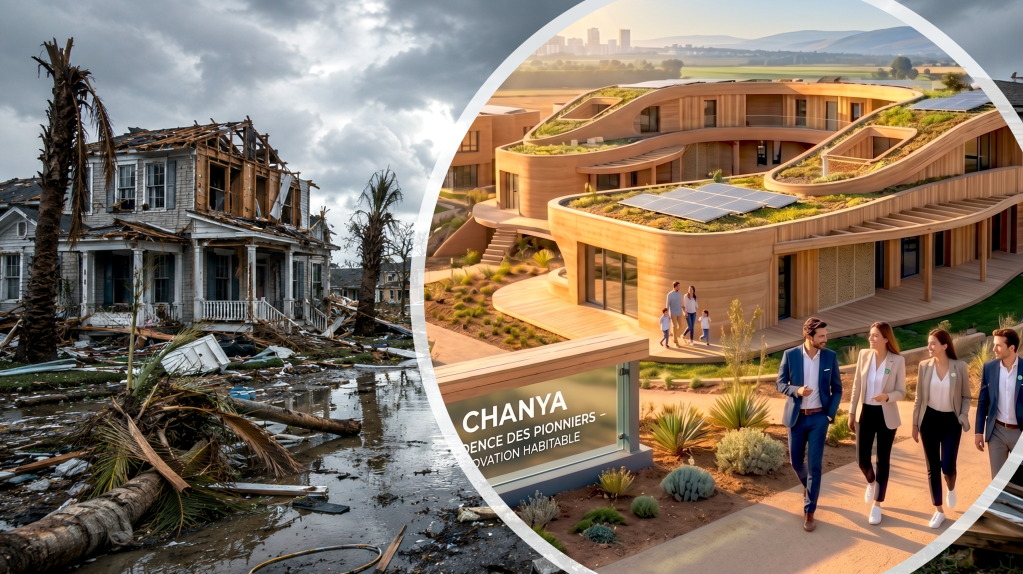
The image accompanying this article illustrates that contrast.
On one side, a neighborhood devastated by an extreme weather event. Wooden homes reduced to debris. Families displaced. Lifetimes of memories erased in a matter of minutes.
On the other, a different vision of the future: architecture conceived from the beginning to respond to environmental realities rather than ignore them.
This is not about aesthetics.
It is about resilience.
We cannot control nature.
But we can control how we build.
For centuries, engineering has evolved by learning from failure. Earthquake-resistant buildings emerged because cities collapsed. Modern fire regulations were written after devastating urban fires. Aviation became extraordinarily safe because every accident was studied, understood, and transformed into better design.
Climate resilience deserves the same mindset.
Instead of asking:
« How can we rebuild after the next disaster? »
Perhaps we should ask:
« Why are we still building structures that repeatedly fail under conditions we already understand? »
Technology should solve recurring problems.
Innovation is often celebrated for being faster, cheaper, or more spectacular.
Its real purpose is much simpler:
to solve problems that humanity faces repeatedly.
Advanced manufacturing, artificial intelligence, robotic construction, bio-based materials, digital engineering, and performance-driven design are not technological luxuries.
They are tools that allow us to rethink housing from first principles.
Can a building better withstand hurricanes?
Can construction become faster after disasters?
Can homes produce less carbon while offering greater resilience?
Can housing become both affordable and durable?
These are no longer futuristic questions.
They are today’s engineering challenges.
Resilience should become the new standard.
Too often, resilience is treated as an optional upgrade—something reserved for premium projects or regions exposed to obvious risks.
That approach belongs to another era.
Extreme weather is becoming less exceptional and more frequent.
Resilience should no longer be viewed as a luxury.
It should become a fundamental design criterion, just like structural safety or energy efficiency.
The cost of building better is almost always lower than the cost of rebuilding everything.
A different philosophy
At CHANYA, we believe construction should begin with a simple question:
What kind of habitat will still serve people fifty years from now?
That question naturally leads toward solutions combining regenerative architecture, bio-based materials, artificial intelligence, robotic manufacturing, and performance-driven engineering.
Technology itself is never the objective.
Creating safer, more sustainable, and more accessible places to live is.
Innovation only becomes meaningful when it improves human lives.
The future is not about resisting change.
It is about adapting intelligently.
Nature is not our enemy.
Storms are becoming stronger because our climate is changing. Pretending otherwise will not protect our communities.
Our responsibility is not to fight nature.
It is to design with enough humility to learn from it.
The buildings of tomorrow should not merely survive the next storm.
They should embody a new way of thinking—one where resilience, sustainability, and accessibility are no longer competing priorities, but parts of the same vision.
Because the question is no longer whether climate will continue to change.
The question is whether we are willing to change with it.

